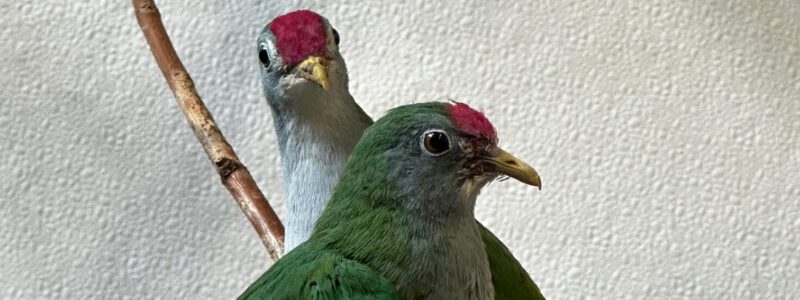
Beautiful Fruit Dove
McCormick Bird House
McCormick Bird House is open 10 a.m.–4:30 p.m.
Did You Know?
- Beautiful fruit doves are also called rose-fronted pigeons or crimson-capped fruit doves. Despite their small size, they can eat whole fruits with a volume of up to 2 inches.
- Although they are known for their brightly colored feathers, beautiful fruit doves are able to effectively camouflage in the forests where they live.
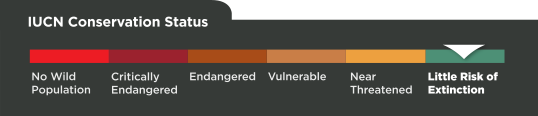
- This bird species has a large native range, where it is common and considered a species of Least Concern, according to the International Union for Conservation of Nature. Beautiful fruit dove numbers have not been quantified, but they are considered to be slowly declining.
Don’t See the Animals?
Why aren’t animals visible at all times? To promote positive animal welfare, we provide animals with choices. They can choose to spend time in areas that are out of public view.

Take an Animal Home with You
Overview
Scientific Name: Ptilinopus pulchellus
Diet: Whole fruits, berries, seeds
Range: New Guinea, West Papua islands of Indonesia
Endangered Status: Least Concern
More Information
Beautiful fruit doves are distinguished by their crimson forehead, yellow bill, gray face and chest, red chest banding, and an orange-yellow belly. Males and females look the same and can be up to 8 inches in length. These small, non-migratory birds prefer lowlands and mid-elevation forests in areas with high rainfall. They make a mournful, descending “woo-ooo” or a rapid “wooloo” sound.
These birds generally live alone or in pairs. When courting, males puff out their chests and stretch their bodies while vocalizing for females. Females lay a single egg at a time, then incubate it for 15–18 days in a delicate nest of twigs. Once hatched, chicks are fed a special secretion from the parents called “crop milk.” They grow quickly and can fly within two weeks after hatching.