Whitebelly Reed Frog
Whitebelly Reed Frog
During the week, Regenstein Small Mammal-Reptile House is open 10 a.m.–4:30 p.m.
On Saturday and Sunday, Regenstein Small Mammal-Reptile House is open 10 a.m.–6:30 p.m.
Did You Know?
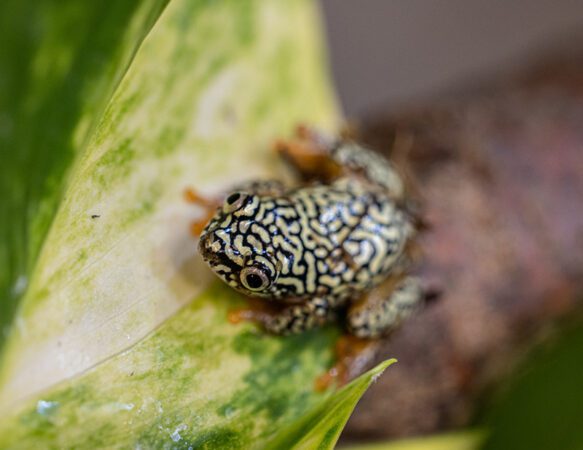
- Because of their light markings on dark skin, which act as camouflage, these amphibians are also called starry night reed frogs.
- Male reed frogs have vocal sacs that inflate with air to create more resonant calls. A gular (throat) patch on the vocal sac emits chemical signals that make up part of a complex communication system.
- Open spaces are increasing in Madagascar due to human development, meaning that there is actually more habitat available for whitebelly reed frogs.
Don’t See the Animals?
Why aren’t animals visible at all times? To promote positive animal welfare, we provide animals with choices. They can choose to spend time in areas that are out of public view.

Take an Animal Home with You
Overview
Scientific Name: Heterixalus alboguttatus
Class: Reptile
Diet: Insects
Range: Madagascar
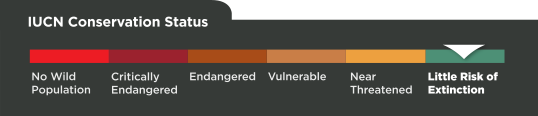
Endangered Status: Least Concern
More Information
Whitebelly reed frogs are sexually dimorphic. The larger females have bright yellow spots along their back and limbs, while males are generally more muted in color with brown, olive, or gray tones. Some males may have faint spots, but others will not have spots at all. These small frogs reach less than 2 inches in length and have a light-colored belly that gives them their name.
Endemic to the African island of Madagascar, whitebelly reed frogs prefer living in open savannahs, forest, swamps, grasslands, and agricultural areas. They reproduce well in temporary and permanent freshwater bodies, including rice fields. Egg clutches contain several hundred eggs that take two weeks to hatch. After two to six months as tadpoles, they change into frogs.